
|
|
|
|
.. tools & data; view/rank/compare/analyze housing value trends .. metros (here) .. 3-digit ZIP Code .. 5-digit ZIP Code December 2022 .. for 2022Q3, the Housing Price Index (HPI) for North Port-Sarasota-Bradenton, FL MSA had the highest percent increase over the year 2021Q3 to 2022Q3 among all 373 metros tabulated. Use the interactive table below to examine quarterly HPI, a measure of housing value appreciation. HPI data are also available by 3 and 5-digit ZIP code and census tract, The HPI is calculated in part using home sales price information from Fannie Mae- and Freddie Mac-acquired mortgages. Visual Analysis of Quarterly HPI Patterns by Metro The following graphic shows patterns of housing value appreciation based on the 2022Q3 Housing Price Index (HPI) MSA and MSA-MD. Click graphic for larger view. Expand browser window to full screen for best view. Larger view shows metros labeled with HPI. 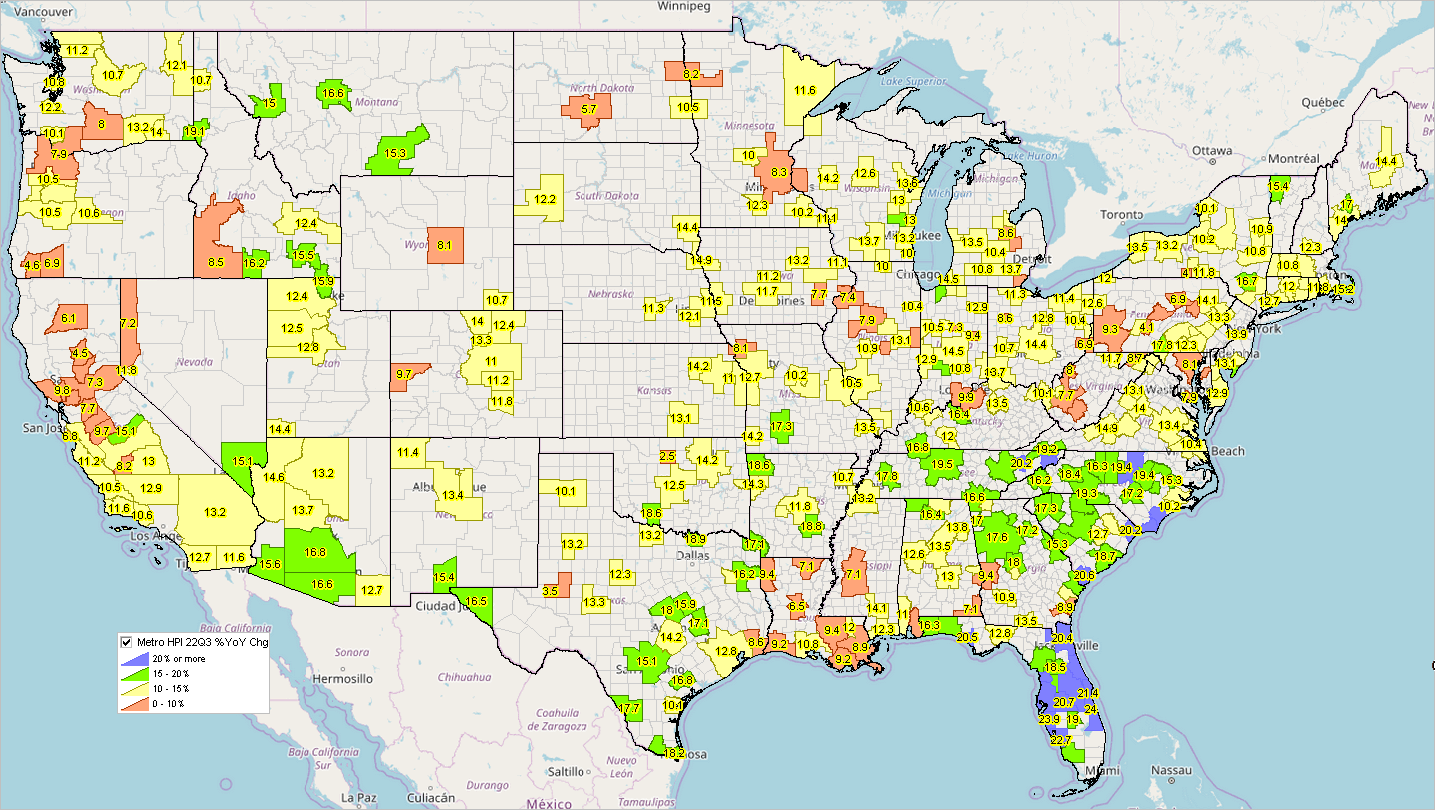 - view developed using CV XE GIS and related GIS project. - Click graphic for larger view and details. Upcoming Release Dates .. goto top This section updates with quarterly HPI by metro as new data are developed: 02.28.23 HPI 2022Q4 05.30.23 HPI 2023Q1 08.29.23 HPI 2023Q2 11.28.23 HPI 2023Q3 See calendar to view HPI release dates in context of related data/topics. Using Tools & Data Resources in this Section .. goto top Use tools in this section to examine the quarterly HPI from 2018Q1 to 2019Q1. View/rank/compare HPI trends using the interactive table (see below). Use the GIS tools to visually and geospatially analyze patterns and characteristics of interest. Members of the ProximityOne User Group may download the HPI GIS project and use this project and datasets with the CV XE GIS software. Develop variations on maps shown in this section; add your own data. Use the interactive table below to view/rank/compare the non-seasonally adjusted "all transactions" HPI for each/all vintage 2020 Metropolitan Statistical Areas (MSAs). The ranking table shows the latest quarterly HPI data and preceding quarters. Housing Price Index by Metro Interactive Table - 2021Q1 - 2022Q3 .. goto top The Housing Price Index (HPI) is based on a value of 100 in 1995 Q1 Click column header to sort; click again to sort other direction. See related interactive demographic-economic tables Housing Market Data & Analytical Resources The HPI alone provides only partial insights -- based on this one measure. Evaluation of housing markets, and the regional economy, trends and patterns need to use the HPI in combination with many other measures. • Situation & Outlook database & information resources • Metro Reports - examine HPI in context of other measures .. click MSA (HPI only available for MSAs) link in table at right to view metro .. see HPI in metro table of contents section (5.4.) • HPI Sections .. HPI by Metro quarterly (this section) .. HPI by 5-Digit ZIP Code annual • annual population estimates: county, metro, state, U.S. • ACS demographic-economic tables: metro, state, U.S. • Housing Unit Time Series, Trends & Patterns • Housing market conditions • ProximityOne Data Services: access/integrate these with other data • Each data resource section has associated GIS project & datasets. • CVGIS software: data analytics, maps, geospatial analysis • See related Interactive Tables Steps to Develop Custom HPI Pattern Analysis Maps (requires Windows computer with Internet connection) 1. Install the ProximityOne CV XE GIS ... run the CV XE GIS installer ... take all defaults during installation 2. Download the HPI GIS project fileset ... requires UserID ... unzip HPI GIS project files to local folder c:\hpigis 3. Open the c:\hpigis\hpi_us1.gis project ... after completing the above steps, click File>Open>Dialog ... open the file named c:\hpigis\hpi_us1.gis 4. Done. The start-up view is shown at top of this section. About the Housing Price Index ... scroll section
The Housing Price Index (HPI) is a broad measure of the movement of single-family house prices.
It serves as a timely, accurate indicator of house price trends at various geographic levels.
It also provides housing economists with an analytical tool that is useful for estimating changes in the rates of mortgage defaults,
prepayments and housing affordability in specific geographic areas.
The HPI is based on data developed by the Federal Housing Finance Agency (FHFA) using data provided by Fannie Mae and Freddie Mac.
The HPI is a measure designed to capture changes in the value of single-family homes in the U.S. by state and metropolitan area. The HPI equals 100 for all MSAs in the first quarter of 1995. States and divisions are normalized to 100 in the first quarter of 1980. The difference in normalization dates has no impact on appreciation rates obtained from the index. HPI data are estimates subject to errors of estimation. Transactions Covered by HPI The House Price Index is based on transactions involving conforming, conventional mortgages purchased or securitized by Fannie Mae or Freddie Mac. Only mortgage transactions on single-family properties are included. Conforming refers to a mortgage that both meets the underwriting guidelines of Fannie Mae or Freddie Mac and that does not exceed the conforming loan limit. For loans originated in 2009, the loan limit has been set by the American Recovery and Reinvestment Act of 2009. That Act, in conjuction with prior legislation, allows for loan limits up to $729,750 for one-unit properties in certain high-cost areas in the contiguous United States. The purchase-only and all-transactions HPI track average house price changes in either repeat sales or refinancings on the same single-family properties. The purchase-only index is based on more than 7 million repeat sales transactions, while the all-transactions index includes more than 50 million repeat transactions (includes refinance appraisals). Both indexes are based on data obtained from Fannie Mae and Freddie Mac for mortgages originated over the past 39 years. How the HPI is Computed The HPI is a weighted, repeat-sales index, meaning that it measures average price changes in repeat sales or refinancings on the same properties. This information is obtained by reviewing repeat mortgage transactions on single-family properties whose mortgages have been purchased or securitized by Fannie Mae or Freddie Mac since January 1975. The HPI is updated each quarter as additional mortgages are purchased or securitized by Fannie Mae and Freddie Mac. The new mortgage acquisitions are used to identify repeat transactions for the most recent quarter and for each quarter since the first quarter of 1975. Comparison to Related Housing Price Measures Census Bureau Constant Quality House Price Index (CQHPI). The FHFA HPI covers far more transactions than the Census survey. The CQHPI covers sales of new homes and homes for sale, based on a sample of about 14,000 transactions annually, gathered through monthly surveys. The quarterly HPI is based on more than 38 million repeat transaction pairs over 34 years. This gives a more accurate reflection of current property values than the Census index. The HPI also can be updated efficiently using data collected by Fannie Mae and Freddie Mac in the normal course of their business activity. S&P/Case-Shiller Home Price Index. Both FHFA and C-S HPIs employ the same fundamental repeat-valuations approach, there are a number of data and methodology differences. Among the dissimilarities: . The S&P/Case-Shiller indexes only use purchase prices in index calibration, while the all-transactions HPI also includes refinance appraisals. The FHFA purchase only series is restricted to purchase prices, as are the S&P/Case-Shiller indexes. . FHFA valuation data are derived from conforming, conventional mortgages provided by Fannie Mae and Freddie Mac. The S&P/Case-Shiller indexes use information obtained from county assessor and recorder offices. . The S&P/Case-Shiller indexes are value-weighted, meaning that price trends for more expensive homes have greater influence on estimated price changes than other homes. The FHFA index weights price trends equally for all properties. . The geographic coverage of the indexes differs. The S&P/Case-Shiller National Home Price Index, for example, does not have valuation data from 13 states. The FHFA U.S. index is calculated using data from all states. Support Using these Resources [goto top] Learn more about demographic economic data and related analytical tools. Join us in a Data Analytics Lab session. There is no fee for these Web sessions. Each informal session is focused on a specific topic. The open structure also provides for Q&A and discussion of application issues of interest to participants. ProximityOne User Group [goto top] Join the ProximityOne User Group to keep up-to-date with new developments relating to geographic-demographic-economic decision-making information resources. Receive updates and access to tools and resources available only to members. Use this form to join the User Group. Additional Information ProximityOne develops geodemographic-economic data and analytical tools and helps organizations knit together and use diverse data in a decision-making and analytical framework. We develop custom demographic/economic estimates and projections, develop geographic and geocoded address files, and assist with impact and geospatial analyses. Wide-ranging organizations use our tools (software, data, methodologies) to analyze their own data integrated with other data. Follow ProximityOne on Twitter at www.twitter.com/proximityone. Contact us (888-364-7656) with questions about data covered in this section or to discuss custom estimates, projections or analyses for your areas of interest. |
|
|
